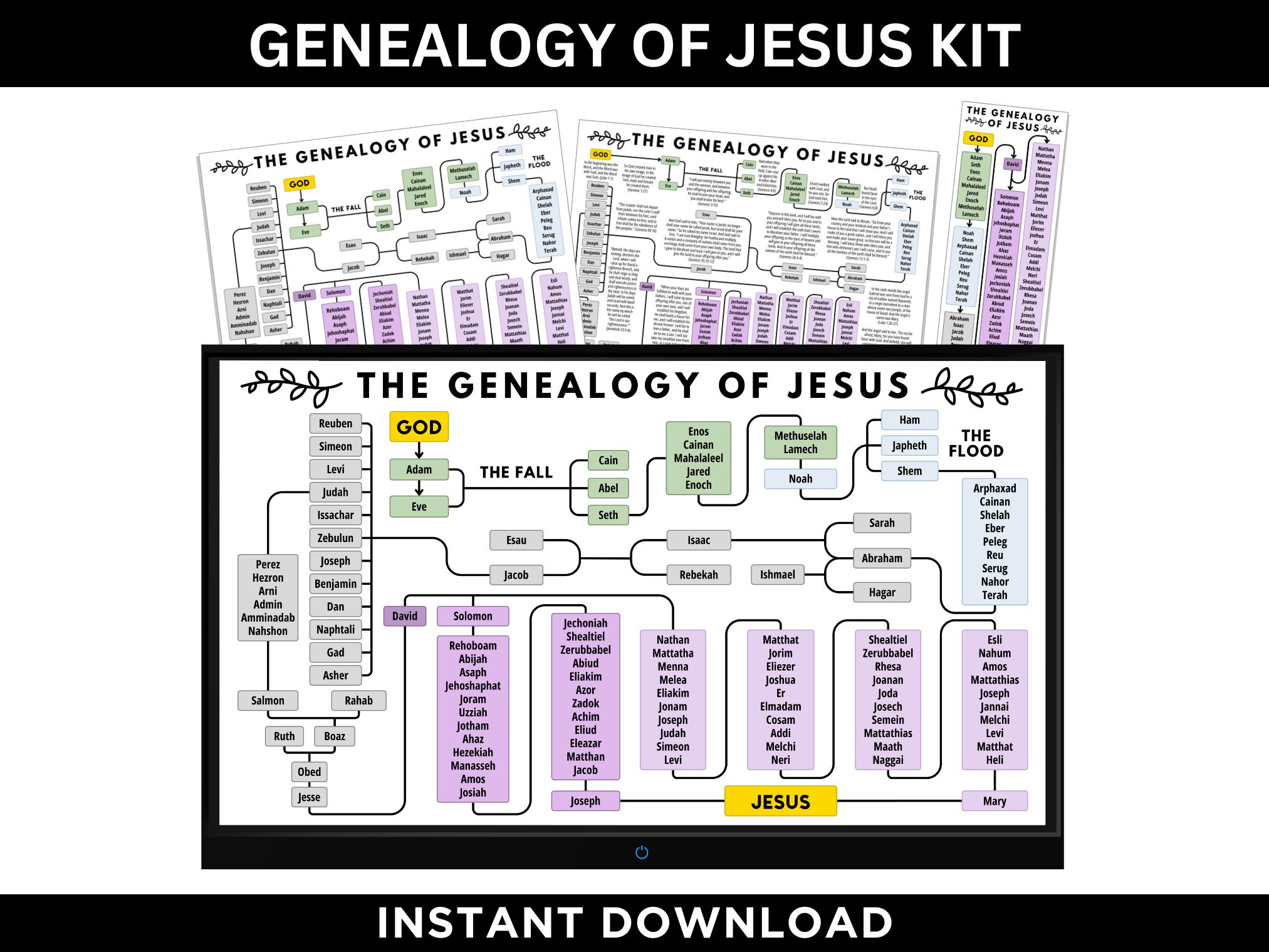

The Genealogy of Jesus is a fascinating and intricate part of Christian theology, deeply rooted in the New Testament. It provides a detailed lineage that traces Jesus' ancestry back to King David and ultimately to Adam, the first man. This genealogy is presented in two separate accounts in the Gospels of Matthew and Luke, each offering unique perspectives and serving different theological purposes. Understanding the Genealogy of Jesus not only enriches our knowledge of biblical history but also sheds light on the divine plan and the fulfillment of Old Testament prophecies.
The Genealogy in Matthew
The Gospel of Matthew presents the Genealogy of Jesus in the first chapter, beginning with Abraham and culminating in Jesus. This genealogy is structured in three sets of fourteen generations, each set highlighting a significant period in Israel’s history:
- From Abraham to David
- From David to the Babylonian exile
- From the exile to Jesus
Matthew’s genealogy emphasizes Jesus’ royal lineage, connecting Him directly to King David. This is crucial because it fulfills the prophecy in 2 Samuel 7:12-16, where God promises David that his throne will be established forever through his descendants. By tracing Jesus’ lineage through David, Matthew underscores Jesus’ role as the Messiah and the rightful heir to David’s throne.
The Genealogy in Luke
The Gospel of Luke also provides a Genealogy of Jesus, but it differs from Matthew’s account in several ways. Luke’s genealogy is longer and traces Jesus’ lineage back to Adam, the first man. This genealogy is presented in Luke 3:23-38 and is structured in a descending order, starting from Jesus and going back to Adam. Luke’s genealogy includes several women, which is unusual for the time and highlights the inclusion of Gentiles in God’s plan of salvation.
Luke’s emphasis on tracing Jesus’ lineage back to Adam underscores the universal scope of Jesus’ mission. It shows that Jesus is not just the Savior of the Jews but the Savior of all humanity. This genealogy also emphasizes Jesus’ humanity, as it connects Him to the entire human race, from the first man to the last.
Key Differences Between Matthew and Luke
The Genealogy of Jesus as presented in Matthew and Luke has several key differences that have been the subject of much scholarly debate. Some of the notable differences include:
- Number of Generations: Matthew’s genealogy has 42 generations, while Luke’s has 77 generations.
- Names and Order: There are discrepancies in the names and order of the generations between the two accounts.
- Inclusion of Women: Luke includes several women in his genealogy, such as Tamar, Rahab, Ruth, and Bathsheba, which is not the case in Matthew’s account.
- Joseph’s Lineage: Matthew traces Jesus’ lineage through Joseph, while Luke traces it through Mary, although this is not explicitly stated in the text.
These differences have led to various theories and interpretations, but they ultimately serve to highlight different aspects of Jesus’ identity and mission. Matthew’s genealogy emphasizes Jesus’ royal and messianic lineage, while Luke’s genealogy emphasizes His universal and human lineage.
Theological Significance of the Genealogy
The Genealogy of Jesus holds profound theological significance for Christians. It serves as a bridge between the Old and New Testaments, showing how God’s promises to the patriarchs and prophets are fulfilled in Jesus. Some of the key theological points include:
- Fulfillment of Prophecy: The genealogy shows how Jesus fulfills numerous Old Testament prophecies, such as those concerning the Messiah’s descent from David and Abraham.
- Divine Plan: It reveals God’s sovereign plan in history, orchestrating events and lineages to bring about the salvation of humanity.
- Humanity and Divinity: The genealogy underscores Jesus’ full humanity, as He is part of the human lineage, while also hinting at His divinity through His unique birth and role as the Messiah.
- Inclusion of Gentiles: The inclusion of Gentiles in the genealogy, particularly in Luke’s account, highlights God’s plan to include all nations in His salvation.
By understanding the Genealogy of Jesus, Christians gain a deeper appreciation for the intricate and beautiful tapestry of God’s redemptive plan.
Historical and Cultural Context
The Genealogy of Jesus must be understood within its historical and cultural context. In ancient Jewish society, genealogy was of utmost importance. It determined social status, inheritance, and religious privileges. The ability to trace one’s lineage back to prominent figures like Abraham and David was a source of pride and legitimacy. For Jesus, whose lineage is traced back to these figures, it provided a strong foundation for His messianic claims.
Moreover, the cultural context of the time emphasized the importance of lineage in establishing authority and legitimacy. By presenting Jesus’ genealogy, the Gospel writers were addressing the cultural expectations of their audience, providing a solid basis for Jesus’ claims to be the Messiah and the Son of God.
The Role of Women in Luke’s Genealogy
One of the most intriguing aspects of Luke’s Genealogy of Jesus is the inclusion of several women. This is unusual for the time, as genealogies typically focused on male lineages. The women mentioned in Luke’s genealogy are:
| Name | Significance |
|---|---|
| Tamar | A Canaanite woman who married Judah’s sons and later bore him twins, Perez and Zerah, through deceit. |
| Rahab | A Canaanite prostitute who helped the Israelite spies and later married Salmon, one of the spies. |
| Ruth | A Moabite woman who remained loyal to her Israelite mother-in-law, Naomi, and later married Boaz. |
| Bathsheba | The wife of Uriah the Hittite, with whom King David had an affair, leading to the birth of Solomon. |
| Mary | The mother of Jesus, who conceived Him through the Holy Spirit. |
These women are notable for their faith, courage, and significant roles in the history of Israel. Their inclusion in the genealogy underscores the theme of God’s grace and redemption, as these women were often marginalized or stigmatized in their societies. It also highlights the universal scope of God’s plan, as it includes both Jews and Gentiles.
📝 Note: The inclusion of these women in Luke's genealogy is often seen as a deliberate choice to emphasize the role of women in God's redemptive plan and to highlight the universality of Jesus' mission.
The Messianic Expectation
The Genealogy of Jesus is deeply intertwined with the messianic expectations of the Jewish people. The Old Testament contains numerous prophecies about the coming Messiah, many of which are fulfilled in Jesus’ lineage. Some of the key prophecies include:
- Descendant of Abraham: Genesis 12:3 promises that through Abraham’s seed, all nations will be blessed. Jesus, as a descendant of Abraham, fulfills this promise.
- Descendant of David: 2 Samuel 7:12-16 promises that David’s throne will be established forever through his descendants. Jesus, as a descendant of David, fulfills this promise.
- Born of a Virgin: Isaiah 7:14 prophesies that a virgin will give birth to a son, who will be called Immanuel. Jesus’ birth to the Virgin Mary fulfills this prophecy.
By tracing Jesus’ lineage back to these key figures, the Gospel writers demonstrate how Jesus fulfills these messianic expectations and prophecies. This not only validates Jesus’ claims to be the Messiah but also shows the continuity between the Old and New Testaments.
The Universal Scope of Salvation
The Genealogy of Jesus also highlights the universal scope of God’s salvation plan. Both Matthew and Luke’s genealogies include Gentiles, showing that God’s plan of salvation is not limited to the Jewish people but extends to all nations. This is particularly evident in Luke’s genealogy, which includes women like Rahab and Ruth, who were Gentiles. The inclusion of these figures underscores the theme of God’s grace and redemption, as it extends beyond ethnic and cultural boundaries.
This universal scope is further emphasized in the New Testament, where the apostles preach the gospel to both Jews and Gentiles, showing that God’s salvation is for all who believe in Jesus Christ. The Genealogy of Jesus serves as a foundational text for this universal mission, as it shows that Jesus’ lineage includes both Jews and Gentiles.

The Genealogy of Jesus is a rich and complex part of Christian theology that provides deep insights into Jesus’ identity, mission, and the fulfillment of Old Testament prophecies. By understanding the genealogies presented in Matthew and Luke, Christians gain a deeper appreciation for the intricate and beautiful tapestry of God’s redemptive plan. The genealogies not only validate Jesus’ claims to be the Messiah but also highlight the universal scope of God’s salvation, as it extends to all nations and peoples. The inclusion of women in Luke’s genealogy further underscores the theme of God’s grace and redemption, as it includes those who were often marginalized or stigmatized in their societies. Ultimately, the Genealogy of Jesus serves as a bridge between the Old and New Testaments, showing how God’s promises to the patriarchs and prophets are fulfilled in Jesus Christ.
Related Terms:
- genealoy of jesus list
- the genealoy of jesus christ
- understanding the genealoy of jesus
- genealoy of jesus explained
- jesus family tree chart
- genealoy of jesus chart