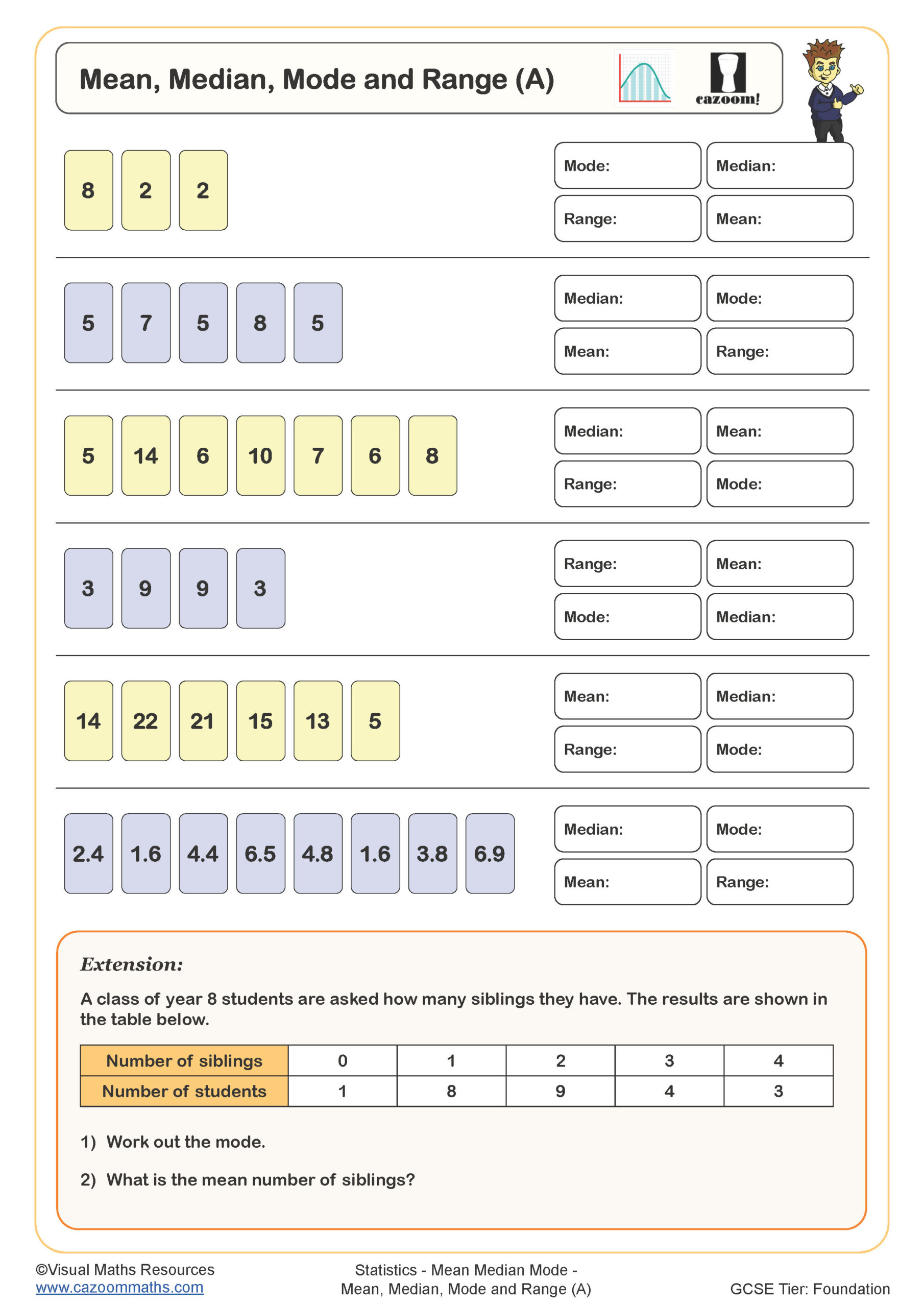

Mastering basic statistics is a fundamental milestone in every student's mathematical journey. Understanding how to interpret data allows learners to make sense of the world around them, from analyzing sports scores to understanding weather patterns. One of the most effective ways to solidify these concepts is through consistent practice with a high-quality Mean Median Mode Range Worksheet. These four statistical measures—collectively known as measures of central tendency and variation—provide a comprehensive snapshot of any data set. By engaging with structured exercises, students transition from simple rote memorization to a deep, conceptual understanding of how numbers interact within a group.
The beauty of statistics lies in its universal application. Whether a student is in middle school or preparing for high school entrance exams, the ability to calculate the average, find the middle value, identify the most frequent number, and determine the spread of data is essential. A well-designed Mean Median Mode Range Worksheet serves as a bridge between theoretical classroom instruction and practical problem-solving. In this guide, we will explore each of these concepts in detail, provide step-by-step calculation methods, and offer strategies for educators and parents to help their students excel in data analysis.
The Importance of Data Literacy

In the modern age, data is everywhere. We are constantly bombarded with percentages, averages, and trends. Data literacy—the ability to read, work with, and communicate data—is no longer an optional skill; it is a necessity. Using a Mean Median Mode Range Worksheet helps students develop this literacy by forcing them to look beyond the individual numbers and see the "story" the data is telling. When a student calculates the mean, they are looking for the "fair share." When they find the range, they are measuring the diversity or consistency of the information.
Educators often find that statistics is one of the more engaging branches of mathematics because it can be easily localized. You can collect data from the classroom, such as the number of siblings each student has or the height of students in inches. By applying the concepts found in a Mean Median Mode Range Worksheet to real-life scenarios, the math becomes tangible and less intimidating. This hands-on approach fosters a positive attitude toward STEM subjects and builds a strong foundation for more advanced topics like probability and standard deviation.
Defining the Four Pillars of Basic Statistics
Before diving into the exercises provided by a Mean Median Mode Range Worksheet, it is crucial to have a clear understanding of what each term represents. Each measure offers a different perspective on a set of numbers.
- Mean: This is commonly referred to as the "average." It is calculated by adding all the numbers in a set and dividing the sum by the total count of numbers.
- Median: This is the middle value in a data set when the numbers are arranged in numerical order. If there is an even number of values, the median is the average of the two middle numbers.
- Mode: The number that appears most frequently in a data set. A set can have one mode, more than one mode (bimodal or multimodal), or no mode at all.
- Range: The difference between the highest and lowest values in a set. It indicates how spread out the data is.
By mastering these four pillars, students can describe the "typical" value in a group and understand how much variation exists. This is why a Mean Median Mode Range Worksheet usually presents problems that require calculating all four values for a single set of data, as it encourages students to see the relationship between them.
Step-by-Step Guide to Calculating the Mean

The mean is perhaps the most widely used statistical measure. We use it to determine grade point averages, batting averages in baseball, and the average temperature for a month. Calculating the mean is a two-step process that reinforces addition and division skills.
To calculate the mean using your Mean Median Mode Range Worksheet, follow these steps:
- Sum the Values: Add every number in the data set together to find the total sum.
- Count the Values: Determine how many individual numbers are in the set (this is often represented by 'n').
- Divide: Divide the total sum by the number of values.
For example, if a data set is {5, 10, 15, 20}, the sum is 50. Since there are 4 numbers, you divide 50 by 4, resulting in a mean of 12.5. It is important to remind students that the mean does not have to be one of the numbers in the original set.
💡 Note: When working with large numbers or decimals, encourage students to double-check their addition before proceeding to the division step to avoid carry-over errors.
Mastering the Median: Ordering is Key

The most common mistake students make when using a Mean Median Mode Range Worksheet is forgetting to order the data. The median is the physical middle of the set, but it only works if the numbers are lined up from least to greatest (or greatest to least).
The median is particularly useful because it is not affected by "outliers"—numbers that are significantly higher or lower than the rest of the group. For instance, if you are looking at home prices in a neighborhood, one multi-million dollar mansion could skew the mean, but the median would remain a more accurate representation of the "middle" home price.
Finding the Median:
- Step 1: Rewrite the data set in ascending order.
- Step 2: If the number of values is odd, the median is the exact middle number.
- Step 3: If the number of values is even, locate the two middle numbers, add them together, and divide by 2.
Consider the set {3, 1, 9, 7, 5}. Ordered, it becomes {1, 3, 5, 7, 9}. The median is 5. If we add the number 11 to the set ({1, 3, 5, 7, 9, 11}), the two middle numbers are 5 and 7. The median becomes (5+7)/2 = 6.
Identifying the Mode and Range
The mode and range are often considered the easiest to find, yet they provide vital information. The mode tells us about popularity or frequency, while the range tells us about consistency. In a Mean Median Mode Range Worksheet, these are often calculated alongside the mean and median to provide a full analysis.
The Mode is found by simply counting occurrences. If a data set is {2, 4, 4, 6, 8, 10}, the mode is 4. If no number repeats, the set is said to have no mode. If 4 and 6 both appeared twice, the set would be bimodal.
The Range is the distance between the extremes. To find it, identify the maximum value and the minimum value, then subtract the minimum from the maximum. A small range suggests that the data points are very close together (consistent), while a large range suggests they are spread far apart (variable).
| Measure | How to Find It | Common Use Case |
|---|---|---|
| Mean | Sum of all values / number of values | Calculating a final grade in school. |
| Median | Middle value in an ordered list | Comparing household incomes. |
| Mode | Most frequent value | Determining the most popular shoe size sold. |
| Range | Highest value - Lowest value | Checking the temperature fluctuation in a day. |
⚠️ Note: Remind students that the Range is a single number (the result of subtraction), not the two numbers themselves (e.g., "The range is 10," not "The range is 5 to 15").
Effective Strategies for Using a Mean Median Mode Range Worksheet

To get the most out of a Mean Median Mode Range Worksheet, it is helpful to follow a structured approach. Statistics can sometimes be tedious if students view it as just a series of calculations. Here are some strategies to make practice more effective:
- Use Real Data: Instead of just using the generic numbers on the worksheet, have students collect their own data first. This makes the subsequent calculations feel more relevant.
- Color Coding: When ordering numbers for the median, suggest using colored pencils to cross off the smallest and largest numbers from the outside in. This helps students find the true middle without losing their place.
- Visual Aids: Draw a number line. Plotting the data points on a line can help students visualize the "clump" (mode), the "center" (median), and the "spread" (range).
- Work Backwards: Once a student is comfortable, give them the mean and ask them to create a data set that fits. This requires a higher level of critical thinking.
Repetition is key to mastery. A Mean Median Mode Range Worksheet should ideally start with small data sets (3-5 numbers) and gradually increase in complexity to include larger sets, decimals, and even negative numbers. This progression builds confidence and ensures the student is ready for standardized testing formats.
Common Pitfalls and How to Avoid Them
Even for bright students, certain errors tend to crop up frequently when working through a Mean Median Mode Range Worksheet. Being aware of these common mistakes allows for proactive correction.
One major hurdle is the presence of zeros in a data set. Students often skip zeros when calculating the mean, but zero is a value that must be added to the sum and included in the count. For example, the mean of {0, 0, 6} is 2 (6 divided by 3), not 6.
Another common issue is missing the middle when calculating the median of an even-numbered set. Students might just pick one of the two middle numbers instead of finding their average. Constant reinforcement of the "add and divide by two" rule is necessary here. Lastly, ensure that students don't confuse the term "Range" with the "Domain" or other mathematical terms; keeping a clear glossary at the top of the worksheet can help.
Integrating Technology with Worksheets
While pencil-and-paper practice with a Mean Median Mode Range Worksheet is vital for learning the mechanics, integrating technology can enhance the experience. Once students understand the formulas, they can use spreadsheet software like Excel or Google Sheets to verify their answers.
Functions like =AVERAGE(), =MEDIAN(), and =MODE() are standard in spreadsheet applications. Learning these functions alongside manual calculations prepares students for higher-level data analysis and professional environments. You can have a student complete five problems on their Mean Median Mode Range Worksheet and then "audit" their own work using a computer. This creates a feedback loop that reinforces accuracy and introduces technical proficiency.
🔍 Note: Encourage students to estimate the mean before calculating it. If the numbers are between 10 and 20 and they get a mean of 45, they will immediately know they made a calculation error.
Tailoring Worksheets for Different Grade Levels
A Mean Median Mode Range Worksheet can be adapted to suit various educational stages. The core concepts remain the same, but the complexity of the numbers changes.
- Elementary Level: Focus on small whole numbers (1-20). Use visual objects like marbles or fruit to represent the data points.
- Middle School: Introduce larger data sets and decimals. Start incorporating word problems that require students to extract data from a short paragraph.
- High School: Use the Mean Median Mode Range Worksheet as a refresher before moving into standard deviation, variance, and normal distribution curves. Introduce data sets with negative integers.
By adjusting the difficulty, educators can ensure that students remain challenged but not overwhelmed. The goal is to move from the how (the calculation) to the why (the interpretation).
Final Thoughts on Statistical Foundations
Building a strong foundation in statistics is one of the most practical gifts an educator can give a student. Through the diligent use of a Mean Median Mode Range Worksheet, learners gain the tools necessary to analyze information objectively and skeptically. They learn that a single number, like an average, doesn't always tell the whole story, and that looking at the median or range can provide a much clearer picture of reality.
Whether you are a teacher looking for classroom resources or a parent helping with homework, focusing on these core measures of central tendency will pay dividends in the future. As students become more comfortable with these calculations, they will begin to notice statistics in their daily lives—in the news, in video games, and in their own hobbies. This curiosity is the spark that leads to a lifetime of analytical thinking and informed decision-making. Keep practicing, stay consistent, and remember that every data set tells a story waiting to be discovered.
In summary, the journey through basic statistics begins with the simple yet powerful tools of mean, median, mode, and range. By utilizing a structured Mean Median Mode Range Worksheet, students can develop the precision and analytical skills required for academic success. We have explored the definitions of each term, the step-by-step methods for calculation, and the common pitfalls to avoid. From understanding the impact of outliers on the mean to recognizing the importance of ordering data for the median, these concepts form the bedrock of data literacy. As students move from manual calculations to real-world applications and technological integration, they transform from passive consumers of information into active, critical thinkers. Consistent practice ensures that these mathematical principles become second nature, paving the way for more advanced study and a better understanding of the data-driven world we live in.
Related Terms:
- mean median mode range calculator
- median mode worksheet
- mean median mode worksheets
- mean median mode range questions
- mean median mode worksheet pdf